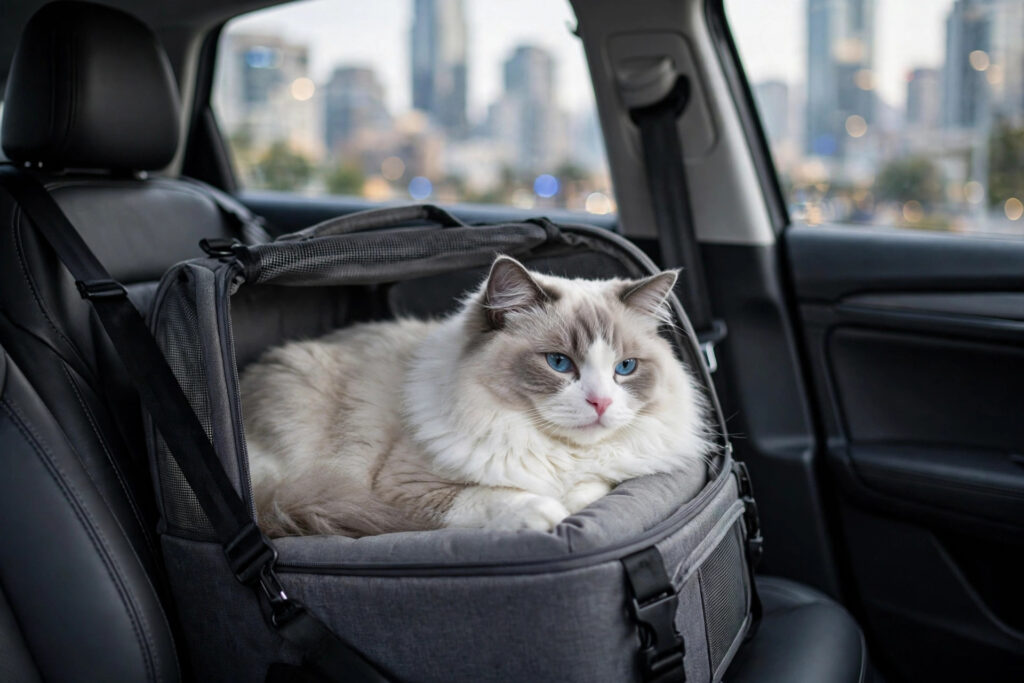
A road trip with a cat goes well when three things are sorted before you start the engine: a carrier your cat already trusts, a car setup that stays calm and secure, and a break rhythm that suits a cat — meaning fewer, quieter stops rather than frequent adventures. Train the carrier at home for a week or two first, keep your cat in the carrier for the whole drive, and plan fuel and food stops around a passenger staying with the car. Do that, and most cats simply sleep through the miles.
Cats have a reputation as terrible travelers. Some of it is earned — the yowling, the drooling, the dramatic betrayal face through the carrier door. But here’s the thing most people miss: cats rarely hate the car itself. They hate the surprise. The carrier only appears on vet days, the car smells like stress and cleaning spray, and suddenly they’re doing 70 down a highway having the worst day of their year.
Remove the surprise and the whole trip changes. Here’s how.
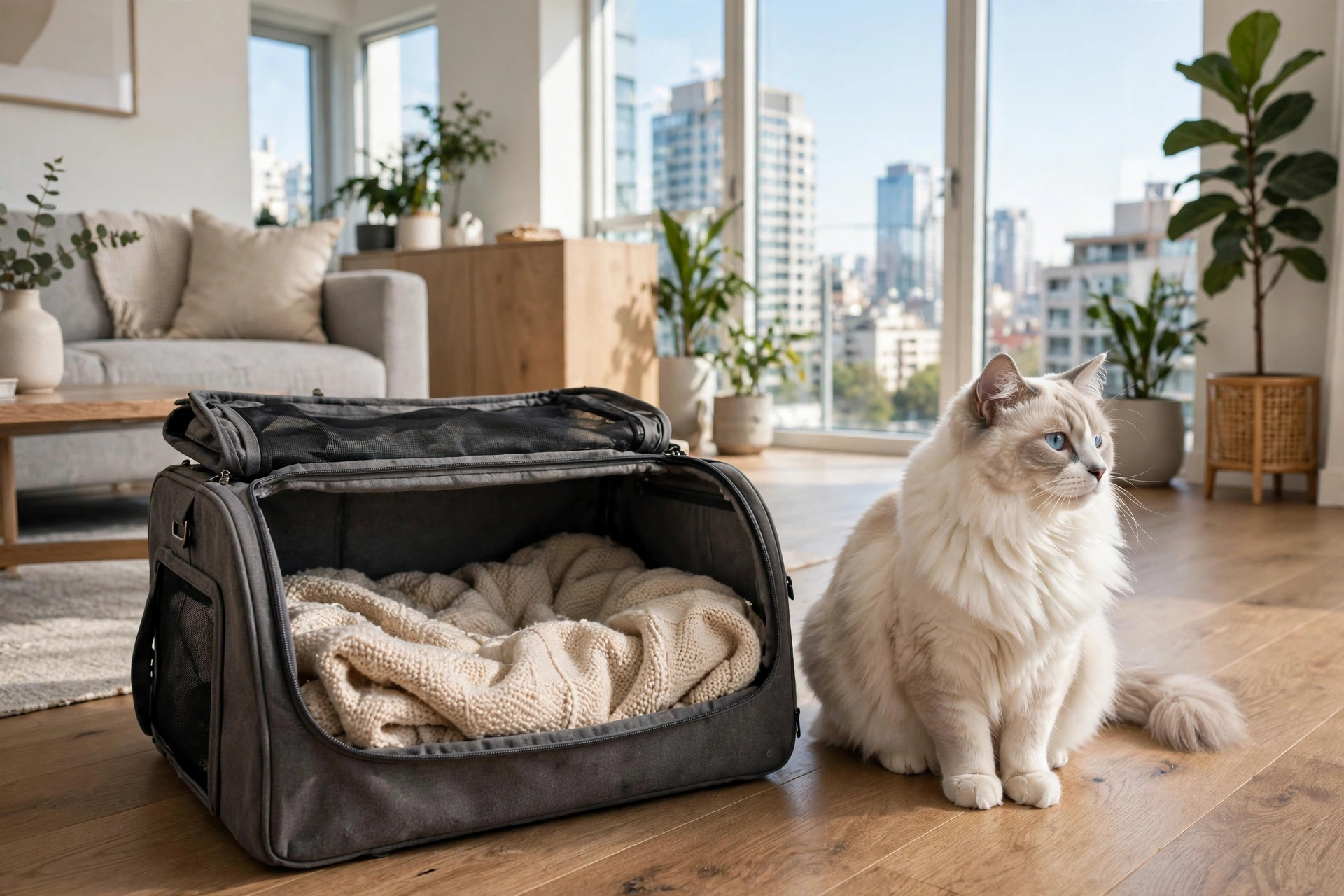
Start two weeks early: the carrier is the whole game
If your cat only sees the carrier when something unpleasant is about to happen, no road-trip trick will save you. So change the association first.
Put the carrier in a room your cat likes, door propped open, with a blanket that smells like home inside. Feed treats in it. Then meals near it, then meals in it. Toss a favorite toy inside during play. You’re not training anything fancy — you’re making the carrier boring. Boring is the goal.
After a few days of that, close the door for a minute while your cat eats, then open it again. Build up. Then short sits in the parked car. Then a five-minute drive around the block. Each step ends with the carrier going back to its spot and normal life resuming.
Two weeks sounds like a lot for a weekend trip. It is also the difference between a cat who naps for three hours and a cat who commentates for three hours. Your call.
Choosing and setting up the carrier
For car travel, a hard-sided carrier or a sturdy soft carrier that holds its shape both work. What matters more:
- Size: big enough for your cat to stand, turn around, and lie stretched out — not so big she slides around in corners.
- Two openings if you can get them. A top door makes loading a reluctant cat far less of a production.
- A washable, familiar-smelling lining. An old T-shirt you’ve worn beats a brand-new pad. Your smell is the sedative.
- Ventilation on at least two sides, and no damage or weak latches. Check the door closure twice. Then a third time.
In the car, the carrier goes on the back seat or the footwell behind a front seat, wedged so it can’t tip or slide, with a seatbelt looped through the handle where the design allows. Never loose in an open boot or cargo area, and never on a lap in the front seat — an airbag deployment with a carrier in front of it is a nightmare scenario you can simply design out.
The day before: packing for a cat, not a kennel
Cats need less than you think, but the right less. Your kit:
- Enough of your cat’s usual food for the trip, plus one spare day. Travel is not the moment for a new brand.
- Water from home in a sealed bottle, and a small spill-proof bowl.
- A compact litter setup for long days: a small tray, a bag of litter, waste bags, and paper towels. Glamorous? No. Essential? Completely.
- Any medication, given on its normal schedule, plus a photo of the prescription label on your phone.
- A recent photo of your cat, in case she ever gets out somewhere unfamiliar and you need one fast.
- Cleaning supplies in reach, not buried: wipes, towels, a spare blanket. Motion sickness happens to good cats on good trips.

One thing to leave behind: the idea of feeding a full meal right before departure. A light meal a few hours before you leave is kinder to a queasy stomach. Water stays available until you go.
On the road: boring is perfect
Cover the carrier with a light blanket if your cat seems overwhelmed — many cats settle faster with less visual noise flying past. Keep the cabin at a comfortable temperature, crack a window for fresh air if it’s mild, and talk normally. Your ordinary voice is reassurance; a constant stream of “it’s okay, baby, it’s okay” tells a cat something is wrong.
Music? Sure, at normal volume. Sudden loud anything? No.
And the rule that outranks all the others: your cat stays in the carrier while the car doors can open. Not “just for a cuddle.” Not at the rest stop “for a stretch.” A loose cat in a strange place is gone in seconds, and cats are astonishingly good at being gone. If you want her out of the carrier at a stop, it happens inside the closed car, or on a harness and leash she’s already trained on at home — never as a first experiment in a parking area next to a highway.
Breaks: fewer than you’d take for a dog
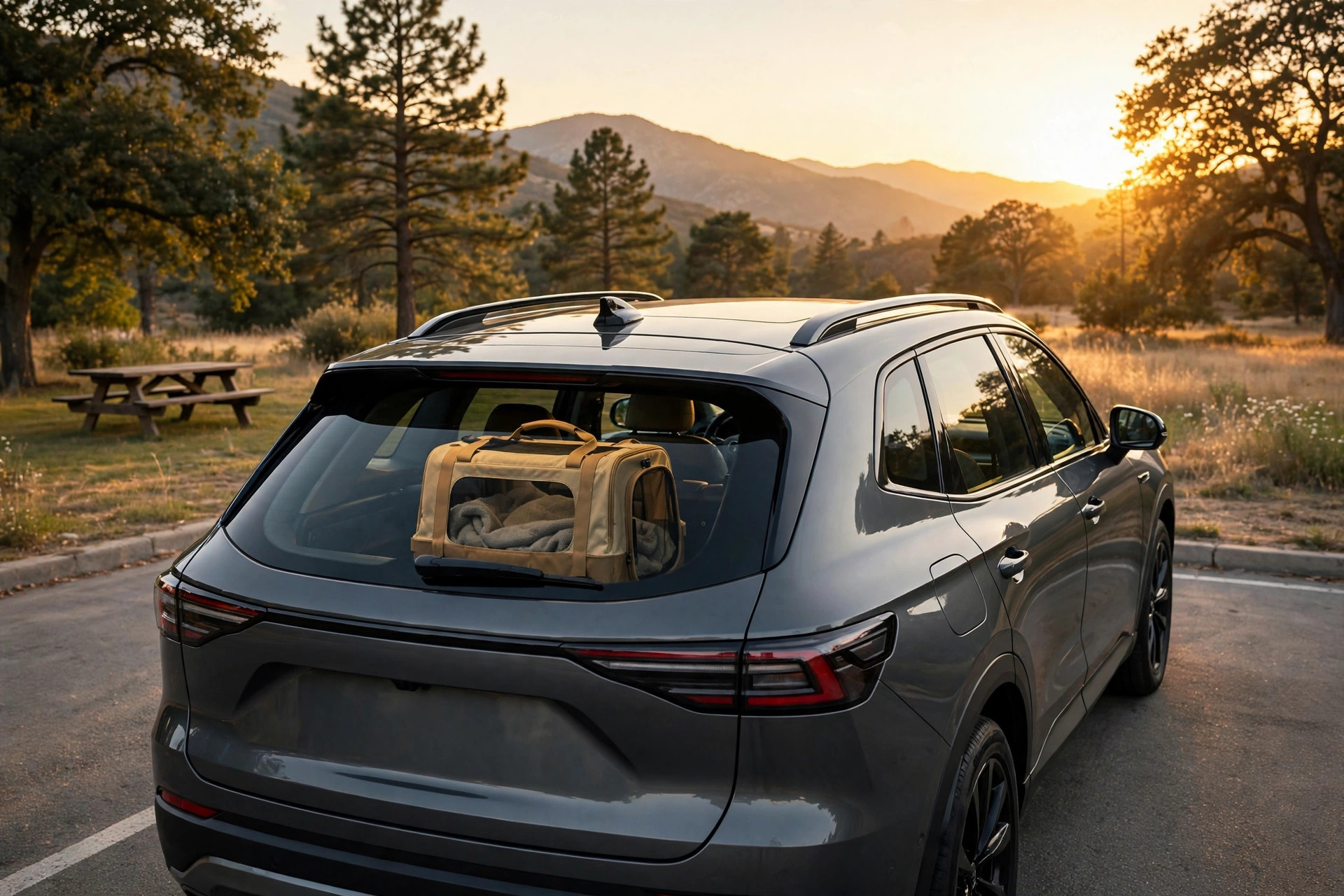
Dogs need the world; cats need predictability. On a drive of a few hours, most cats do best with no carrier-opening breaks at all. For longer days — think six hours and up — one quiet stop is plenty: park away from the dog-walking crowds, keep the doors closed, offer water, and give access to the small litter tray inside the car for ten unhurried minutes.
Your own breaks need a plan too. A cat must never sit in a parked car in warm weather — cabin temperatures climb dangerously fast, even with windows cracked, and “I was only five minutes” is how emergencies start. Travel with a second adult and take turns staying with the car, or plan stops where one of you always remains. If you’re driving solo with a cat, your breaks are the car’s breaks: fuel, stretch, back on the road.
Arriving: one room, then the world
New place, same rule as the carrier: small and boring first. Set up one room with the litter box, water, food, and the open carrier before you let your cat out. Let her emerge on her own schedule — five minutes for the bold, an evening for the thoughtful. Sit on the floor, read something, be furniture. Exploring room by room over a day or two beats a full-house debut that ends with a cat behind the washing machine.

Keep feeding times and food the same as home for the first couple of days. Routine is the language cats read best, and you’ve just moved every landmark they know. Give them the schedule back and most cats file the whole trip under “strange, but survivable” — right up until the drive home, which by then is just the boring box, the familiar blanket, and a nap.
Frequently asked questions
How long can a cat comfortably stay in a carrier in the car?
Most healthy adult cats handle several hours in a carrier without trouble, especially if they sleep. For drives beyond about six hours, plan one quiet in-car break to offer water and litter access inside the closed vehicle.
Should I sedate my cat for a road trip?
Only with medication your own vet has prescribed for your cat, ideally tried once at home first so you know how she responds. Never give human medication, and ask your vet well before the trip — not the day before.
Can my cat ride loose in the car if she’s calm?
No. A calm cat can panic at one loud noise, and a loose cat can slip out at any door opening or get under the pedals. The carrier, secured against sliding, is the safe setup for the entire journey.
What if my cat yowls the whole way?
Start with carrier training at home — most yowling is fear of the unfamiliar, not the car. A light blanket over the carrier, a familiar-smelling lining, and skipping the pre-trip meal all help. If it persists after training, talk to your vet about anxiety options before the next trip.
Is it okay to leave my cat in the car while I grab food?
Not in warm weather, even briefly — parked-car temperatures rise fast and can kill. Travel with a companion who stays with the car, or choose stops where your cat is never left alone in heat.
This article was created with AI assistance and reviewed by our editorial team before publishing.
 Short Trips With a Rabbit: Carrier, Car and Calm Arrivals
 Flying With Your Dog: Cabin vs. Cargo, Explained
 Apartment Living With a Parrot: Noise, Space, Neighbours