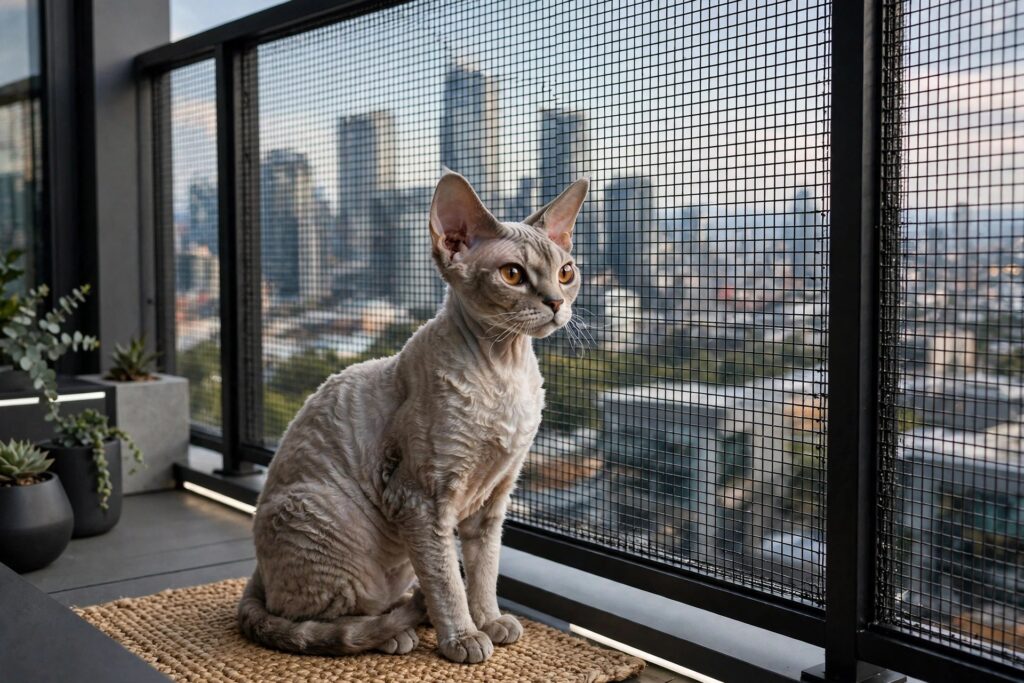
An apartment balcony is safe for a cat only when it’s fully enclosed, from floor to ceiling, with no gap a head can fit through. Screens made for insects won’t hold a cat. Use proper pet mesh or netting, secure every edge, remove climbing launch pads near the railing, and supervise until you trust the setup.
Every apartment cat knows the balcony door sound. Ears up. Eyes wide. A whole outdoor world of pigeons, warm concrete, and interesting smells, sitting right there behind glass.
Your cat isn’t wrong. A balcony can be the best room in a small flat. It just has to be built like an enclosure, not decorated like one. There’s a difference, and cats find it in about four minutes.
Why open balconies are a real risk
Cats are superb climbers and poor judges of height once something flutters past. A bird, a moth, a leaf doing something interesting — and a cat who was sitting calmly a second ago is lunging at the railing.
Vets even have a name for injuries from falls out of windows and off balconies: high-rise syndrome. The ASPCA advises keeping cats off unscreened outdoor ledges and using sturdy screens on windows for exactly this reason. A fall doesn’t need to be from a great height to hurt, either. Landing badly from a low floor can still mean a broken jaw or a damaged lung.
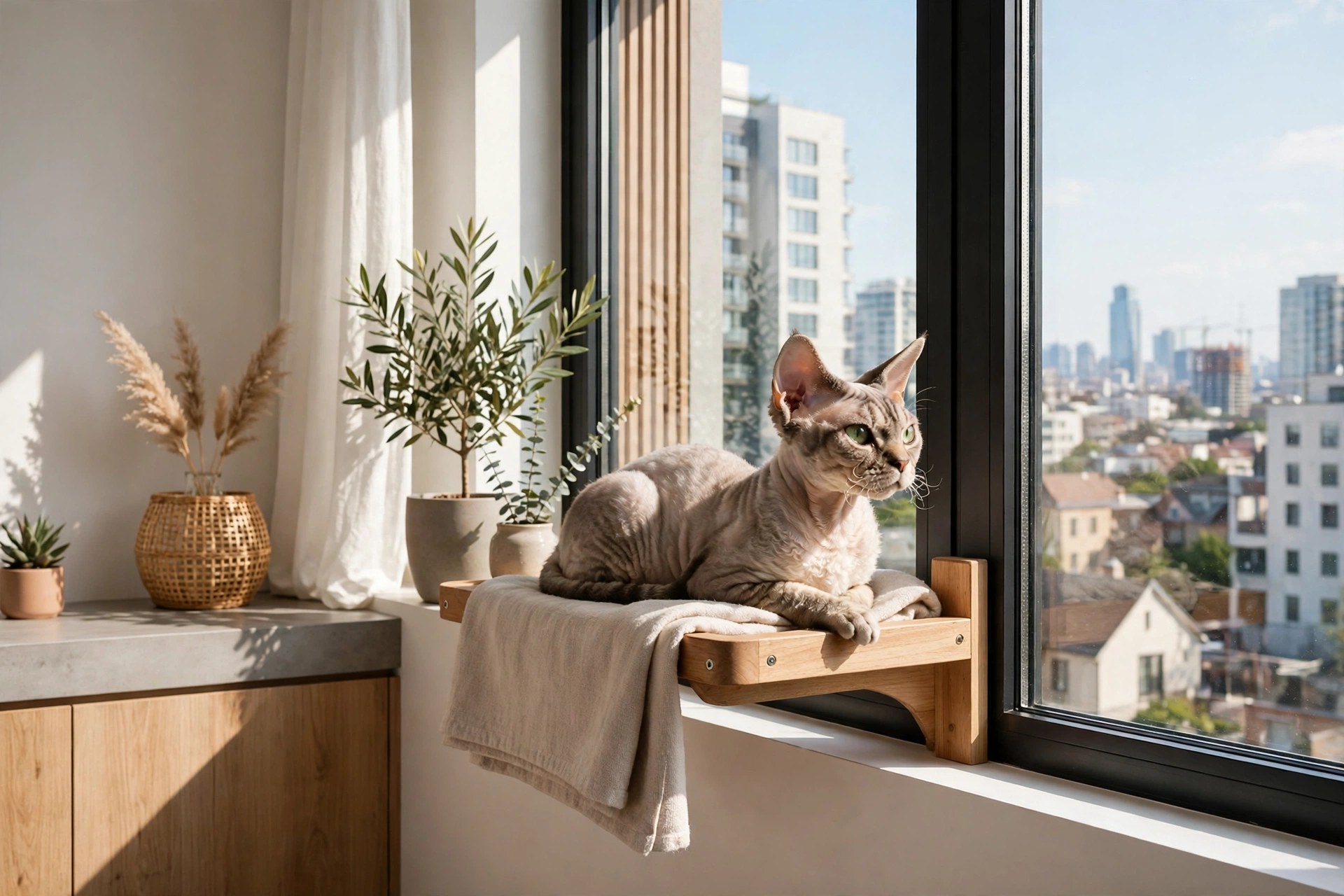
And a fall isn’t the only way out. Cats squeeze. If a head fits through a gap, the body usually follows, which is why wide railing bars that look safe to human eyes can be an open door to a slim cat. A Devon Rex, all ears and lean frame, can look at a gap you’d swear was too small and treat it as an invitation.
Step one: enclose the whole space
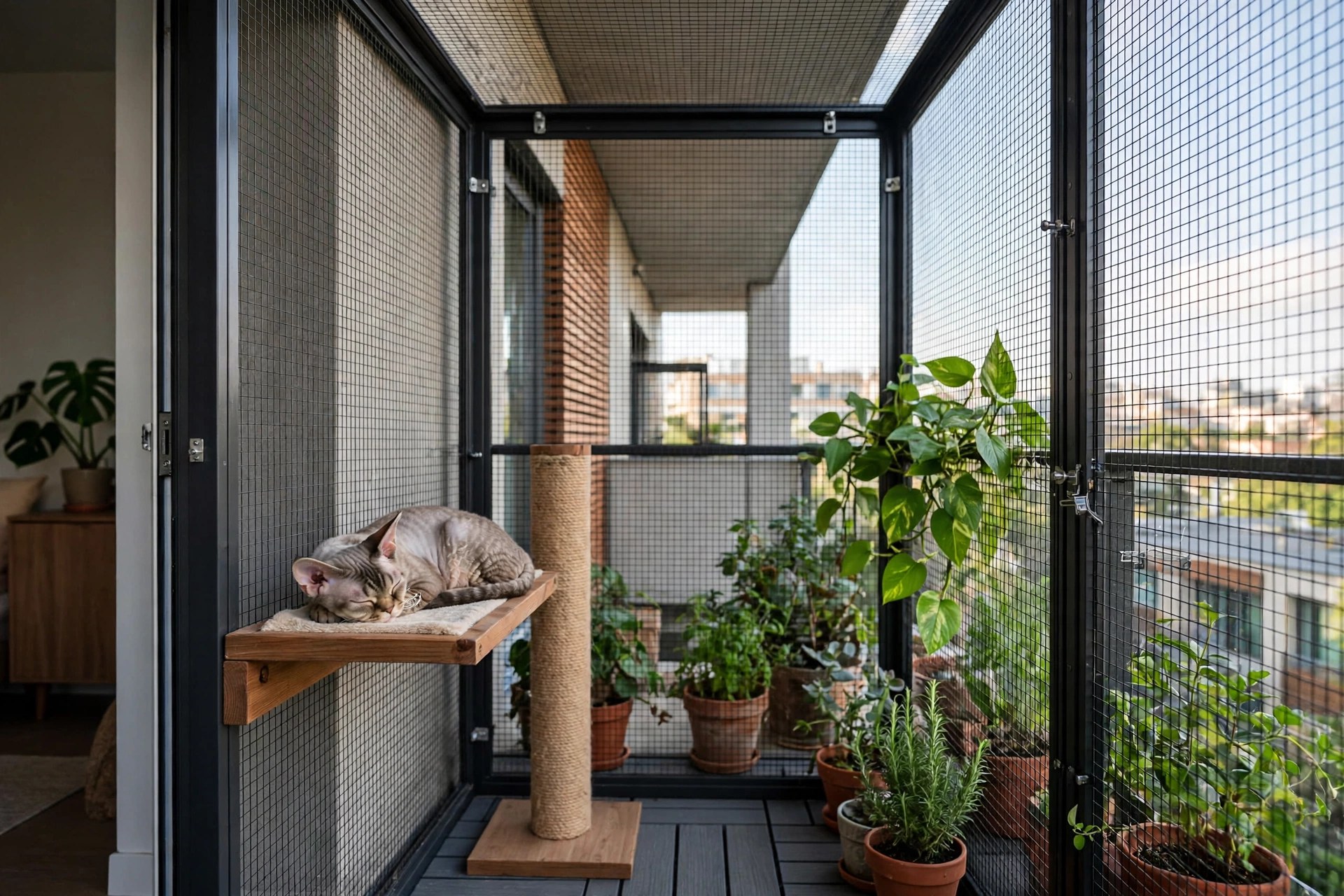
Partial fixes fail. A taller railing panel still leaves the top open to a climbing cat. A net across one side leaves the corner. Think in terms of a box: floor, ceiling, and every side, sealed.
You’ve got three main routes, and your building rules will narrow the choice.
- Balcony netting. Purpose-made cat net, fixed to a frame or anchor points on all sides. Check the mesh is chew-resistant and the fixings are tight enough that a cat leaning its full weight into a corner can’t bow it out.
- Mesh panels. Rigid panels fitted inside the railing and up to the ceiling. Sturdier, often pricier, and usually the neatest finish.
- A freestanding catio. An enclosed pen that sits on the balcony without fixing to the building. This is the renter-friendly route in many flats, since it can come with you when you move.
Whatever you pick, do the push test before your cat gets access. Lean on it. Pull at the corners. Try to open a gap at the bottom with your fingers. If you can make a hole, your cat can make a bigger one.
Step two: remove the launch pads
Enclosure done, now look at the furniture with a cat’s eyes. What’s climbable? What sits close to the mesh? A storage box under the railing is a step. A tall planter is a step on top of the step.
Move tall furniture toward the middle or the wall side of the balcony, and keep the perimeter low. Your cat will still climb things. That’s fine. The goal is that climbing leads to a perch in the middle of the space, not to a testing paw working at the top corner of your netting for an hour.
Speaking of perches, add one on purpose. A shelf or a cat tree inside the enclosure gives the high seat your cat wants, in the place you choose. Cats who get a good lookout spot tend to use it instead of auditioning every other surface.
Step three: deal with heat, plants and small hazards
A balcony in full sun gets hot fast, and cats are bad at leaving a warm spot before they overheat. Always provide shade and a bowl of fresh water out there, and close access during the hottest part of the day if your balcony traps heat. Glass-panelled balconies can act like greenhouses, so check the temperature with your own skin, not a guess.
Plants need a check too. Plenty of popular balcony plants are a bad idea around a cat who chews, and lilies are the headline example: the ASPCA lists true lilies as highly toxic to cats. Keep any plant you haven’t checked outside the enclosure, or skip it entirely.
🌿 Growing lilies or other balcony plants? Check the Eaoae lily safety page for cats — it explains why lilies and cats should never share a balcony, before you plant anything.
Then sweep for the small stuff. Cigarette ends from a neighbour above. Loose screws. Cleaning sprays stored in a corner box. A candle you light in the evening. Balconies collect other people’s dropped hazards, so a quick look before each session becomes a habit worth building.
Harness time is not a substitute
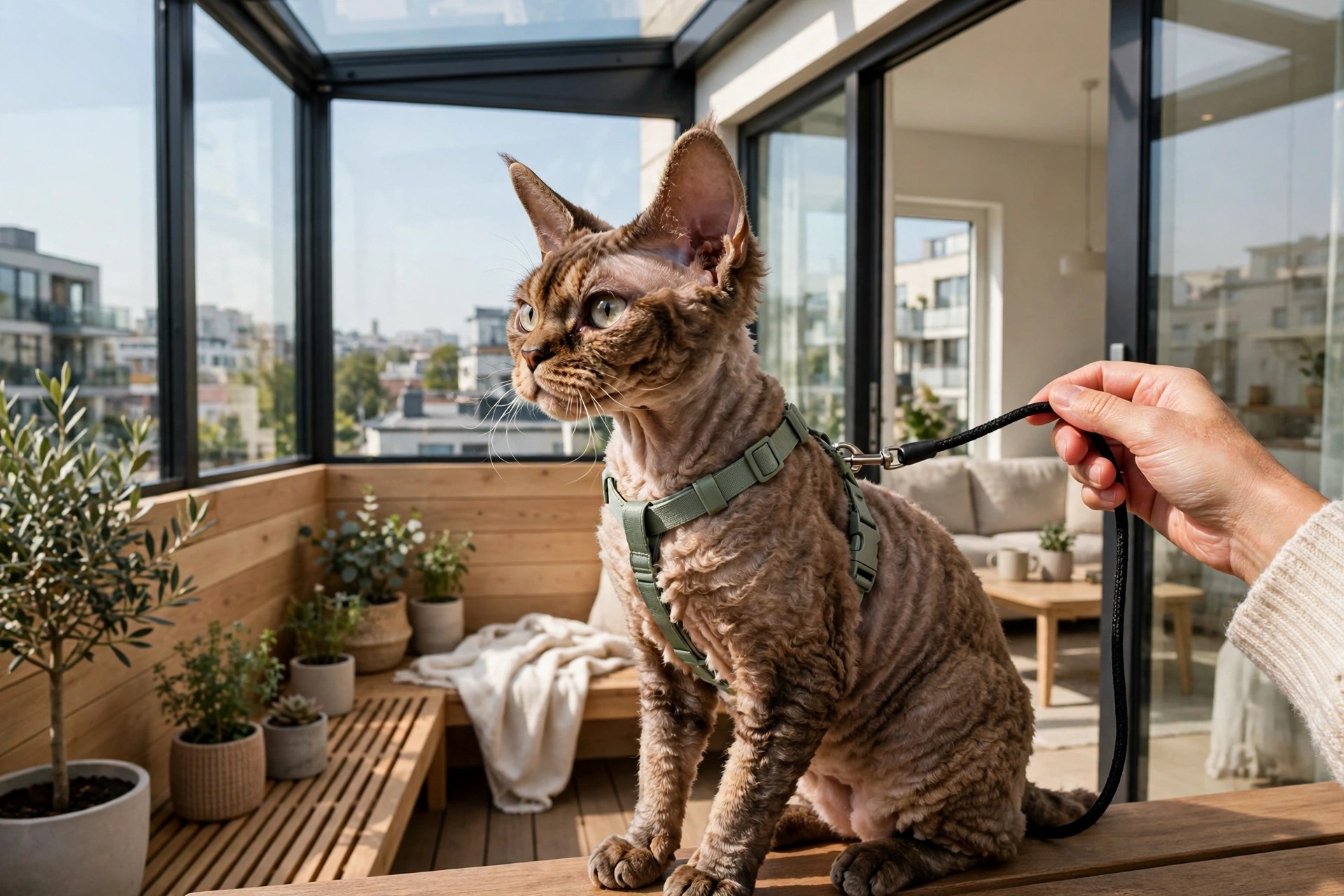
Some owners skip the enclosure and take the cat out on a harness instead. That can work as supervised time, and plenty of cats enjoy it. But be clear about what it is: you, present and paying attention, for the whole session.
A harness doesn’t make an open balcony safe to leave a cat on. Leads tangle around furniture and railings. Cats back out of harnesses that fit badly. And the moment your attention goes to your phone, the arrangement is a cat alone on a balcony with extra string.
If you go this route, fit the harness indoors first, let your cat wear it around the flat, and keep the first balcony visits short. Watch the body language. Flat ears, a low crouch, and constant looking for the door mean the balcony is a stressor, not a treat, and that’s useful information too.
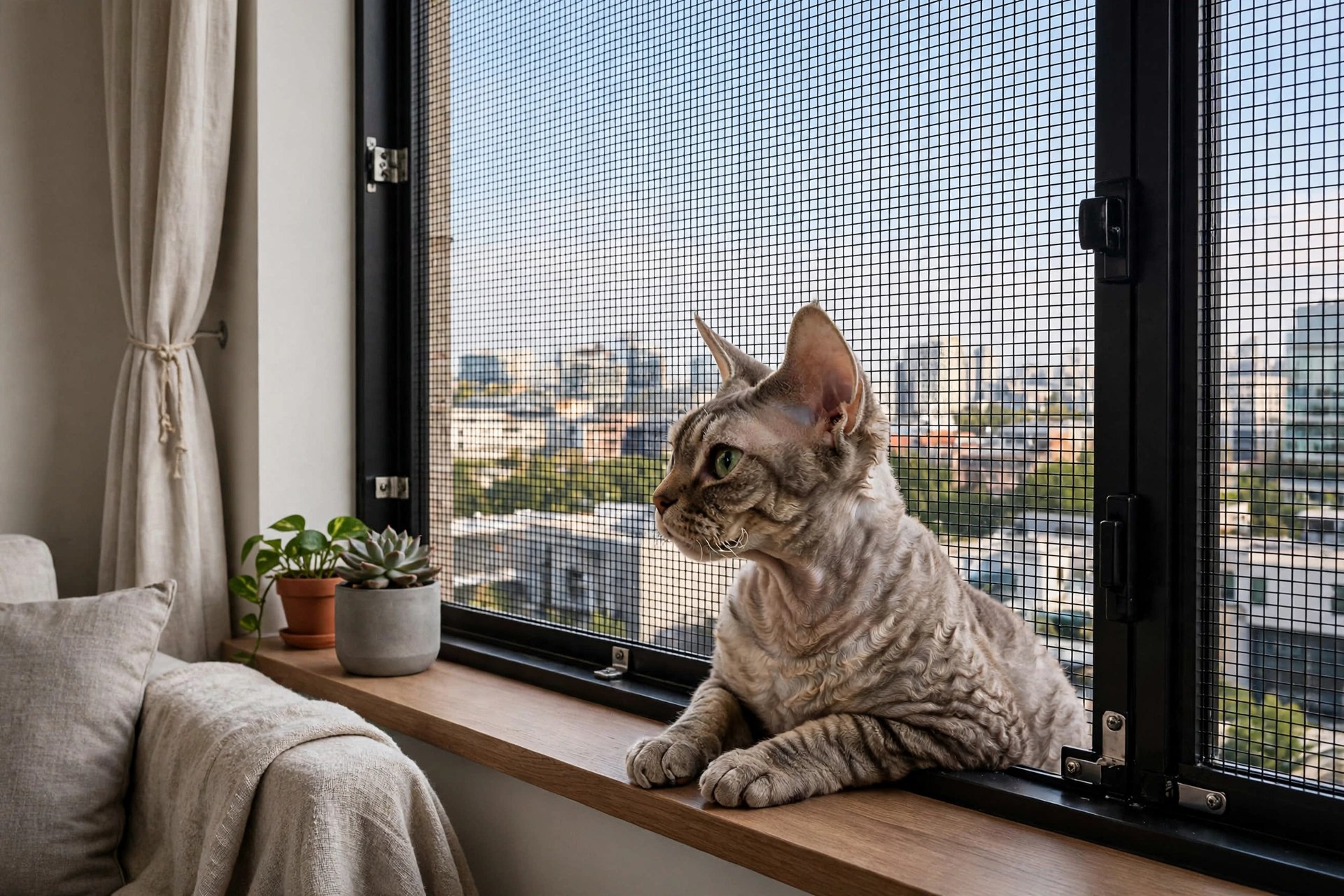
If your building says no to enclosures
Some leases and building rules ban netting and panels outright. Annoying, but not the end of your cat’s window career.
Build the view indoors instead. A wide window perch behind closed, screened glass gives the sun and the pigeons with none of the fall risk. A cat tree by the window does the same job with climbing built in. Window boxes planted outside the glass put the birds on television, safely on the other side.
You can also look at enclosed window boxes made for cats, which project slightly from a window frame inside a mesh cage. Check your building rules first, since some count as exterior fittings. Rules vary a lot between buildings and cities, so read yours rather than copying a neighbour’s setup.
A quick check before every session
- Push on the mesh or netting at the corners. Still tight?
- Run a hand along the bottom edge. Any new gap?
- Shade available, water bowl full?
- Plants, sprays and small dropped objects out of reach?
- Door to the flat propped or held, so your cat can retreat inside?
That takes a minute. Do it anyway. Enclosures fail slowly — a fixing loosens, a corner frays — and a one-minute check is how you catch slow failures before your cat does.
Get this right and the balcony stops being the forbidden door your cat cries at. It becomes a sunny extra room, with a perch, a breeze, and a very superior view of the pigeons. Which, from your cat’s perspective, was the entire point.
Balcony fixes are one part of a wider safety picture. Our guide to apartment living with a pet: the complete city guide covers the rest of the routine, from choosing the right pet to windows, vertical space, and alone time.
Frequently asked questions
Can a cat fall from an apartment balcony?
Yes. Cats chasing insects or birds can lunge over or through railings, and vets call fall injuries high-rise syndrome. The ASPCA advises sturdy screens and keeping cats off unscreened ledges, so a balcony should be fully enclosed before a cat uses it.
Will an insect screen keep my cat on the balcony?
No. Insect screens are made to keep bugs out, not to hold a cat’s weight, and a leaning or lunging cat can push one out. Use purpose-made pet mesh, netting or rigid panels, secured on every edge and checked with a firm push test.
What is the renter-friendly way to make a balcony cat-safe?
A freestanding catio that sits on the balcony without fixings is usually the renter-friendly option, since it encloses the cat without altering the building and can move with you. Confirm your lease allows it, and still check the enclosure before each use.
Are balcony plants safe for cats?
Not automatically. Some popular balcony plants are toxic to cats, and the ASPCA lists true lilies as highly toxic. Check every plant before it shares the balcony, keep unchecked plants outside the enclosure, and remove anything your cat chews that you cannot identify.
This article was created with AI assistance and reviewed by our editorial team before publishing.
 Apartment Living With a Parrot: Noise, Space, Neighbours
 Apartment Living With a Pet: The Complete City Guide
 Small Apartment, Happy Indoor Cat: Setup Guide