
Moving countries with a dog is won or lost long before the airport. Start about 90 days out: audit your dog’s vaccination records and microchip first, because the entry route your dog qualifies for — and the blood-test and endorsement clocks inside it — set the earliest date you can actually fly. Then run the home prep (crate, routine, vet handover) in parallel, not after.
What does a dog actually need to enter the United States?
Every dog, on every route, needs the same baseline: at least six months old on arrival, healthy on the day, a microchip a universal scanner can read, and a receipt from the free CDC Dog Import Form, submitted online before travel. Beyond that, the CDC splits dogs by where they have spent the last six months and where the rabies vaccination was given — only low-risk countries means the form is the whole story, while any high-risk country adds route-specific paperwork, and one route adds a blood test and a booked inspection facility.
That fork is the whole move, so get it settled before you book anything else. A dog vaccinated in the US before a trip, whose owner had the vaccination certification endorsed by USDA before leaving, travels on the lightest high-risk route. A dog vaccinated abroad travels on the heaviest: an official-vet-endorsed foreign certification form, a rabies antibody (titer) result from a CDC-approved laboratory, and a reservation at a CDC-registered animal care facility at the arrival airport. Nobody can tell you which side of the fork your dog is on from a forum post — it depends on your dog’s exact six months and vaccination history, which is why the self-check below exists.
🐾 Check your dog’s exact route before you book: the free US Dog Import Requirements Checker walks your dog’s last six months, vaccination place, departure region and destination, then splits your paperwork into ready, still to do and needs an official check — including the APHIS disease layer and the Hawaii and Guam systems most checklists never mention.
Your moving date is set by the slowest document
People usually pick a moving date, then discover the paperwork cannot be ready by then. Run it the other way round. Each route carries hard clocks that no amount of money speeds up, and your earliest honest moving date is simply the day the slowest clock finishes.
On the foreign-vaccinated route, the titer test is the long pole: the CDC requires the blood sample to be drawn at least 30 days after the dog’s first rabies vaccination, and at least 28 days before entry, with the result coming from a CDC-approved laboratory. Add lab turnaround and the foreign certification form’s own rule — it must be signed and endorsed within 30 days of travel, so it cannot be done early to “get it out of the way” — and a plan that starts 45 days before the flight is already a plan to move the flight. On the US-vaccinated route the trap is different: the USDA endorsement of the vaccination certification has to happen before the dog leaves the United States, full stop. Miss it and, per the CDC’s own FAQ, you fall back to the foreign-vaccinated requirements. And if your trip departs from a region where the animal disease screwworm is known to exist, USDA APHIS adds one more short clock: an official vet’s certificate based on an exam within five days before travel.
One more constraint hides inside the foreign-vaccinated route: the flight does not get to choose the airport. The dog must land at the airport of the CDC-registered facility it is booked into, which is why the facility reservation comes before the flight booking, not after — on some routes there may be one sensible flight a day, or none on the day you wanted. Owners who book a bargain fare into the wrong city discover that the ticket, not the dog, has to change. Treat the facility’s airport as a fixed point and build the itinerary around it.
None of this is difficult. All of it is unforgiving about order. Which is why the timeline below works backwards from the flight, with the documents first and the suitcases last.
The 90-day countdown, backwards from wheels-up
90+ days out — audit, don’t book. Ask your vet to scan the microchip and read the number back against every document you own; a chip that cannot be scanned, or a number that differs by one digit, poisons the whole file. Pull the full vaccination history and work out, honestly, which countries your dog has been in during the last six months. Then run the route checker once, just to learn which route you are on and which clocks apply to you.
60 days out — start the long clocks. If your route needs a titer, the blood draw belongs here at the latest, respecting the 30-days-after-vaccination and 28-days-before-entry marks. Book the CDC-registered facility if your route requires one, and choose flights that land at that facility’s airport — on the foreign-vaccinated route there is no land-border alternative. Start crate training the same week (below), because it also takes about this long.
30 days out — the window opens. The foreign certification form can now be signed and endorsed inside its 30-day validity window. Re-run the dog import checker with your real dates and mark every item have-it or missing; anything still “not sure” gets a call to the official source it points to, not a shrug. Confirm the airline’s own pet rules in writing — cabin or cargo, breed limits, how fresh their health certificate must be — because airlines layer their own rules over the government’s.
Final week — the short clocks. Submit the CDC Dog Import Form if you have not already, and check the receipt against the trip: on the high-risk routes the port printed on it must be the port you actually arrive at. If you are departing a screwworm region, the APHIS vet exam and certificate happen inside this five-day window. Pack a paper folder — receipts, certificates, titer result, vaccination record — plus photos of every page on your phone.
Travel day and the first 48 hours. Arrive with the folder in your hand luggage, not the hold. If your route includes a facility inspection, that happens before your dog comes home with you; without a valid titer on the foreign-vaccinated route, the facility stay is a 28-day quarantine, which is exactly the outcome the 60-day blood draw exists to prevent. Once home: water, a short walk, one quiet room, and sleep — for both of you.

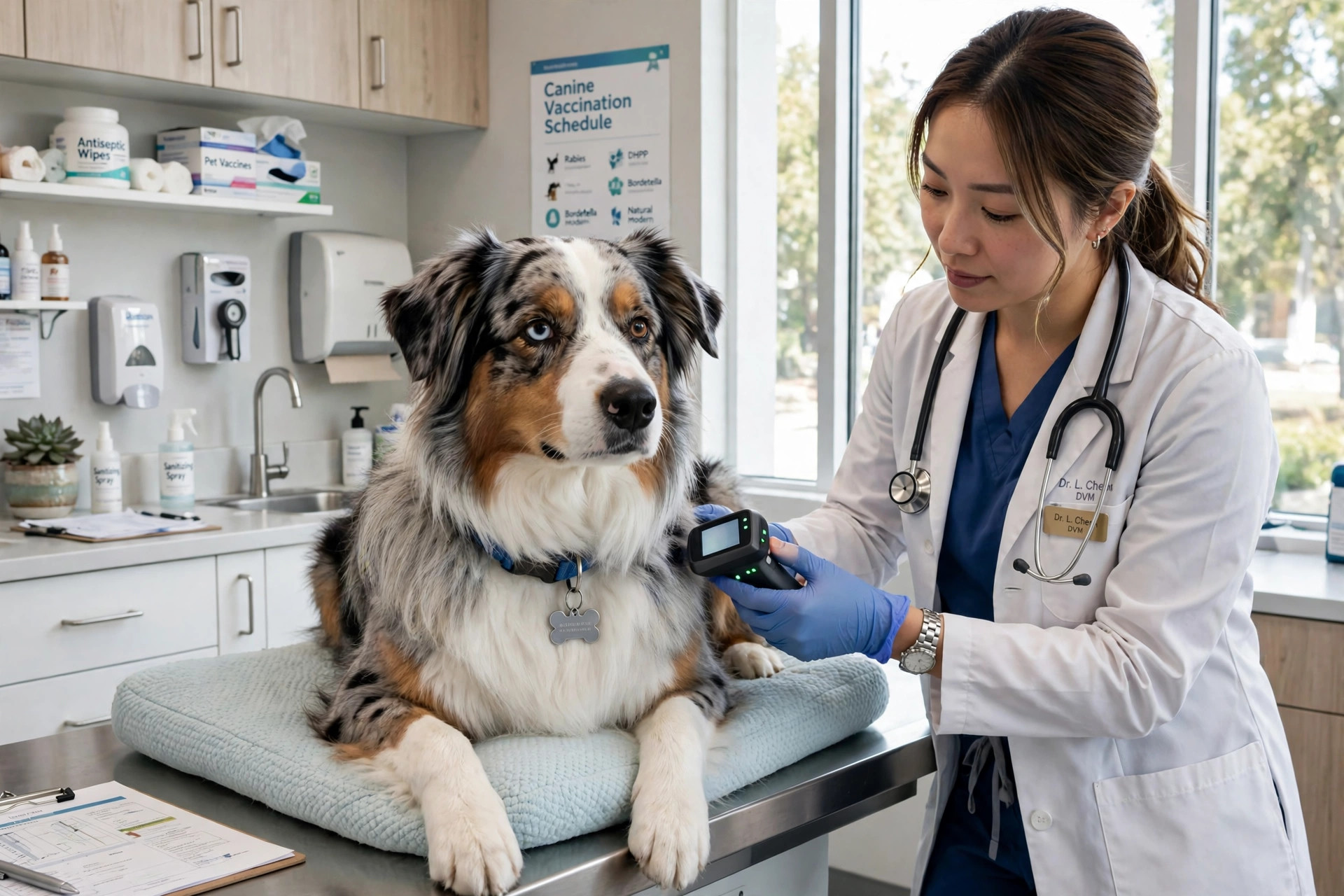
Which vet visits does a relocating dog actually need?
Three, usually: an early records-and-chip audit, a mid-prep visit for anything route-specific like the titer blood draw, and a final pre-travel check timed to whatever your airline and route demand. The mistake is booking one appointment “for the travel papers” a fortnight before the flight — by then the titer window and the endorsement questions are already decided, one way or the other.
Bring the destination into that first conversation. Your home vet knows your dog; the rules of the arrival country are the part owners usually carry in themselves, printed out. If your route involves a facility inspection or any quarantine risk, ask the vet to flag anything in your dog’s health picture that could complicate it — age, a chronic condition, anxiety around strangers — while there is still time to plan around it. And if your dog will need ongoing care after the move, ask for a clean, complete copy of the medical history to hand to the new vet. A two-page summary written by the vet who knows the dog is worth more than a stack of invoices.
Train the trip before you take it
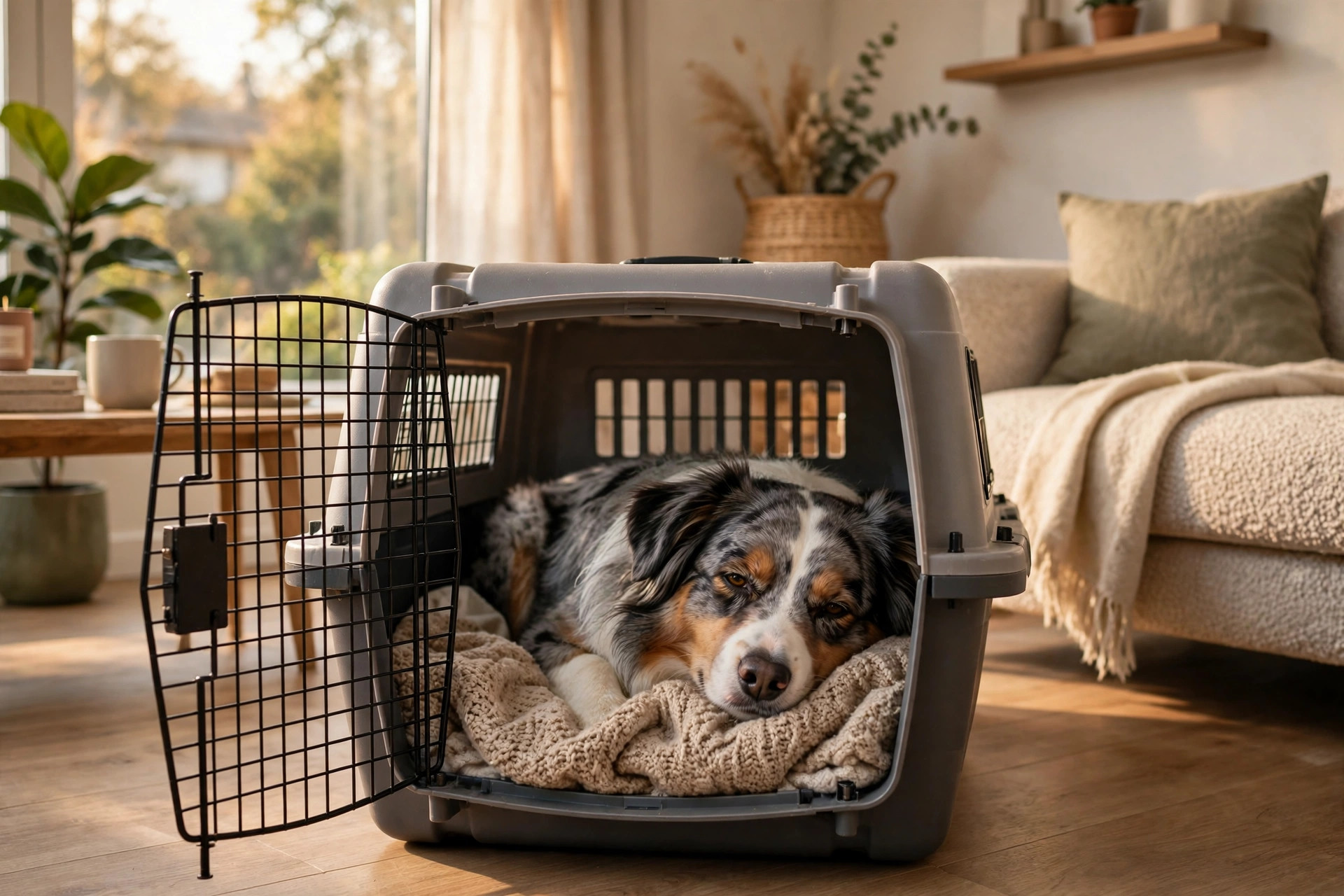
Paperwork gets a dog admitted; preparation gets a dog through the day calmly. The flight itself is mostly a crate problem. A dog that already eats, naps and settles in its travel crate at home experiences the journey as a long, boring version of something familiar. A dog that meets the crate at the airport experiences two new things at once, at maximum volume.
Six to eight weeks is a comfortable runway. Feed meals in the crate with the door open, then closed, then closed while you leave the room. Add the sounds of travel in small doses — recorded airport and aircraft noise at low volume during dinner works — and practise the car ride to the airport if the crate will travel by road first. Keep your own routine boringly normal in the last week: dogs read schedule changes as news. The family that starts packing noisily three weeks out has a mildly anxious dog for three weeks; the family that packs in an evening has one odd evening.
The first week in the new home
Landing is the midpoint, not the finish line. In the first days, keep the world small: one room set up with the familiar-smelling blanket from the crate, water always down, walks on a short route you repeat until it is dull. Most dogs eat lightly and sleep heavily for 48 hours; that is recovery, not a red flag. What does deserve a prompt vet visit is the same list as at home — not eating beyond a couple of days, vomiting or diarrhoea that does not settle, limping, or a dog that cannot seem to rest at all.
Find that vet before you need one. Register within the first week, hand over the medical history summary, and ask what local paperwork they recommend — most cities and counties ask you to license a dog, and many buildings and insurers want vaccination records on file. Rules differ by place, so treat any specific claim you read online (including ours) as a prompt to check your new local authority’s page, not as the rule itself. If you arrived from a foot-and-mouth disease region, one APHIS instruction follows you home: bathe the dog soon after arrival and keep it away from livestock for the first five days — easy in a city, worth knowing on a farm visit.
If the move crossed time zones, shift the routine to the new local clock from the first morning rather than phasing it in. Dogs anchor their day to light, meals and walks far more than to the hour your phone shows, and a clean switch settles faster than a week of half-and-half. Expect one or two very early wake-ups, keep the response boring — out, toilet, back to bed — and the pattern usually re-forms within days.
Then rebuild the anchors. Same feeding times, same walk order, same words for the same things. A relocated dog does not need new adventures in week one; it needs proof that the important patterns survived the move. They did — you are the pattern.

Moving with a dog: straight answers
How far ahead should I start preparing?
About 90 days is comfortable for any route. Sixty days is the practical floor if your dog travels on the foreign-vaccinated route, because the titer test’s two timing marks — blood drawn at least 30 days after the first rabies vaccination and at least 28 days before entry, per the CDC — cannot be compressed. Low-risk-route dogs with tidy records can be ready much faster, but the audit-first order still applies.
Will my dog have to go into quarantine?
Usually not. Quarantine enters the picture on one route only: a dog from a high-risk country, vaccinated abroad, arriving without a valid titer result faces a 28-day quarantine at the CDC-registered facility it was booked into — plan around the full 28 days, even though CDC has a monitored-testing protocol that can shorten the stay in approved cases. Dogs on the low-risk and US-vaccinated routes, and foreign-vaccinated dogs with a valid titer, are inspected and released rather than quarantined. Hawaii and Guam run their own destination systems with their own terms — check those official pages directly if either is your destination.
We are moving within the US, just to Hawaii. Is it the same process?
No — and that surprises people. A domestic move to Hawaii or Guam never touches the CDC import rules, but both destinations run their own animal entry systems that apply to arrivals from the mainland, with their own preparation timelines. Start just as early, and work from the Hawaii Department of Agriculture or Guam Department of Agriculture pages rather than federal ones.
What does the CDC Dog Import Form cost?
Nothing. The form is free to submit on the CDC website, and the receipt is issued electronically. The real costs of a move sit elsewhere: vet visits, the titer laboratory fee if your route needs one, facility charges if your route involves an inspection stay, and the airline’s pet fee. Anyone charging you for the form itself is selling you a free government web page.
Your move-day checklist
- Microchip scanned, and the number matches every document character for character
- Route confirmed against your dog’s real last six months — not the plan, the history
- Every certificate inside its validity window on the actual travel date
- Receipt port and arrival port are the same port
- Paper folder in hand luggage, phone photos of every page
- New vet chosen and records summary ready to hand over
Do those six things and the move becomes what it should be: one long, slightly boring day, after which your dog sleeps in a new home that already smells a little like the old one.
This article was created with AI assistance and reviewed by our editorial team before publishing.
 Travelling With a Guinea Pig: Carrier, Food, Calm Trips
 Ferry Travel With a Small Dog: Deck, Carrier, Calm Crossings
 Booking a “Pet-Friendly” Stay? What to Check Before You Pay